
5 Accounting Red Flags That Destroy M&A Business Valuations
✅ Information Verified by a CPA





Signing a Letter of Intent (LOI) with a private equity buyer or strategic acquirer is an exciting milestone, but it is far from the finish line. An LOI represents an initial offer based on your reported earnings. The real test comes during financial due diligence, where buyers hire specialized audit teams to inspect your historical books line byline.
During this phase, buyers produce a Quality of Earnings (Q of E) report. If their auditors uncover inconsistent accounting, unrecorded liabilities, or unsupported earnings adjustments, the consequences are immediate: re-negotiated purchase prices, severe valuation discounts, hefty escrow holdbacks, or a complete deal collapse.
Understanding the primary financial red flags before entering buy-side scrutiny allows you to fix accounting defects and protect your company’s enterprise value.
Red Flag 1: Cash-Basis Accounting and Missing Revenue Recognition Schedules
One of the fastest ways to stall M&A negotiations is presenting financials prepared on a tax or cash basis rather than GAAP-compliant accrual accounting. Cash-basis accounting records income when cash hits the bank and expenses when checks clear, creating artificially volatile profit swings that obscure true operating performance.
For service providers, tech companies, and product businesses managing multi-stage deliverables or client milestones, buyers require strict revenue recognition and project tracking schedules (such as Work-in-Progress or deferred revenue schedules). A missing or inaccurate revenue tracking schedule hides whether contracts are over-billed or under-billed:
- Over-Billings / Unearned Revenue (Liability): Cash collected from clients before the work is performed or goods are delivered. Buyers view this as unearned income that requires working capital to fulfill post-closing.
- Under-Billings / Unbilled Receivables (Asset): Operational costs and labor incurred on active client projects that have not yet been invoiced. If uncollectible, these write-offs directly reduce historical EBITDA.
Failing to maintain monthly accrual-based revenue matching forces buy-side auditors to adjust your earnings downward to reflect true operating margins.
Red Flag 2: Aggressive or Aggregated Owner Add-Backs
Owners frequently run personal expenses or discretionary costs through their businesses to minimize annual income taxes. While normalizing owner compensation and removing one-time expenses is standard practice in deal-making, submitting unsupported or overly aggressive valuation add-backs instantly damages seller credibility.
Legitimate vs. Unjustified Add-Backs
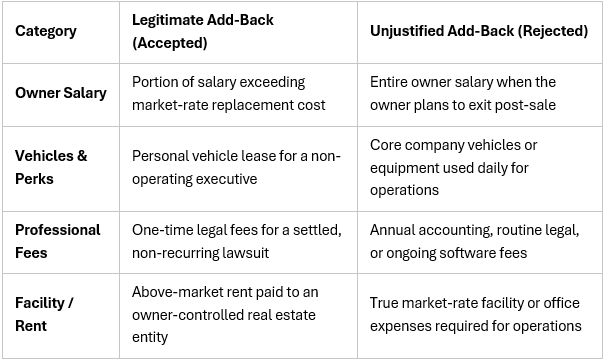
When buy-side auditors reject proposed add-backs during a Q of E review, your EBITDA adjustments drop and because purchase prices are based on multiples, every dollar of rejected add-backs can reduce your final purchase price by 4x to 8x.
Red Flag 3: Severe Customer Concentration Risk
A business showing impressive top-line growth can still be deemed high-risk if a disproportionate share of revenue originates from a handful of clients.
Having a single customer or enterprise client generate more than 15% to 20% of your total annual revenue creates extreme customer concentration risk. Buyers assume that if that primary account churns post-acquisition, the firm's debt service or ROI collapses.
To offset concentration risk during accounting due diligence, sellers must demonstrate long-term contractual relationships, high historical retention rates, and strong gross margins on those core accounts.
Red Flag 4: Unrecorded Deferred Revenue and Warranty / SLA Liabilities
In modern small businesses, recurring service retainers, annual software subscriptions, extended warranties, and multi-quarter service level agreements (SLAs) are powerful drivers of enterprise value. However, they create accounting landmines if managed incorrectly on the balance sheet.
If your firm collects annual contract fees upfront in January but records 100% of that cash as immediate recognized revenue, your profitability is overstated. Under proper accrual accounting vs cash accounting, unearned contract cash must sit on the balance sheet as deferred revenue and be recognized incrementally as services are delivered.
Similarly, if your company offers customer service guarantees, refund policies, or multi-year product warranties but fails to maintain a reserve liability, buyers will calculate a historical liability deduction, reducing reported EBITDA.
Red Flag 5: Mismanaged Working Capital and Negative Peg Balances
In almost every M&A transaction, the agreed-upon purchase price assumes the business will be delivered with a normal level of net working capital, known as the working capital peg.
Net Working Capital = Current Assets(excluding Cash) - Current Liabilities (excluding Debt)
If an owner aggressively collects receivables and delays paying vendor bills, supplier invoices, or contractor payables right before closing to extract extra cash, buy-side auditors will catch the discrepancy. If actual working capital falls below the agreed peg at closing, the shortfall is deducted dollar-for-dollar from the seller's final payout.
The 30-Second M&A Due Diligence Audit
Run this diagnostic to assess if your financial records are ready for buy-side due diligence:
- Financial Format: Are your monthly financial statements prepared on a strict accrual basis with documented revenue recognition schedules?
- Add-Back Documentation: Canyou produce receipts and written justifications for every owner add-backclaimed over the past 36 months?
- Client Diversification: Does your largest single client represent less than 15% of your annual revenue?
- Deferred Revenue: Are upfront annual or quarterly payments tracked as deferred revenue liabilities on your balance sheet?
If you answered "No" to two or more of these questions, your company risks valuation discounts or purchase price renegotiations during M&A financial due diligence.
Conclusion
Navigating M&A financial due diligence requires presenting clean, verifiable financial data long before signing an LOI. By fixing accounting business valuation red flags, establishing GAAP-compliant accrual processes, and validating historical earnings, you maintain leverage at the negotiating table and secure maximum value for your business.
If you are planning an exit within the next 12 to 36 months and need a clear roadmap for M&A readiness, our specialized financial advisory team is here to help. We assist small business owners with Quality of Earnings preparation, earnings normalization, accrual accounting transitions, and strategic CFO guidance built for successful transactions. Book a call with us today to get an audit on your M&A readiness.

About The Author
Daniel Kaufman, is a CPA with over 20 years of experience helping businesses plan with confidence. He helps business owners understand their financial numbers and make smarter decisions for long-term growth. Daniel specializes in small business tax planning, setting up accounting systems, and is a QuickBooks ProAdvisor. He is passionate about giving business owners clarity and confidence through better financial insights.
FAQs
What is a Quality of Earnings (Q of E) report in M&A due diligence?

A Quality of Earnings report is a comprehensive financial audit commissioned by buyers (or proactively by sellers) to evaluate the accuracy, sustainability, and quality of a target company’s reported EBITDA. It verifies whether historical earnings were generated by core operations rather than accounting anomalies or non-recurring events.
How far back do buyers look during financial due diligence?
Buyers typically review 3 to 5 years of historical financial statements, tax returns, general ledgers, bank statements, and payroll records, with an emphasis on the most recent 12 to 24 months (Trailing Twelve Months or TTM).
What is the difference between sell-side due diligence and buy-side due diligence?
Buy-side due diligence is conducted by the purchaser to uncover financial risks and justify a lower purchase price. Sell-side due diligence is conducted proactively by the owner prior to going to market to identify and fix accounting errors, validate add-backs, and streamline the transaction process.
How do unearned revenue and over-billings affect business valuation?
Unearned revenue or over-billings represent cash collected for products or services that have not yet been fully delivered. Buyers view this as a liability because the acquirer will need to spend labor and operational capital post-closing to fulfill those obligations without receiving additional cash inflows.
Why do buyers adjust owner compensation during due diligence?
If an owner takes a below-market salary to inflate reported net income, buyers will adjust earnings downward to account for the true market-rate cost of hiring a replacement executive. Conversely, if an owner overpays themselves, the excess above market rate is added back to EBITDA.
Read More Blogs


HVAC Business Valuation Multipliers: How Buyers Value Mechanical Contracting Firms

Bookkeeper vs Fractional CFO: Which Financial Advisory Does Your Business Need?
Connect with our experienced CFO advisory team
Get Insights
Submit the contact form to receive tailored financial insights and practical guidance from our team
Seamless Experience
Share your needs through the form for quick responses and smooth onboarding support.
Pricing That Makes Sense
After reviewing your inquiry, we provide transparent, practical pricing aligned with your business's financial needs.