
How Digital Marketing Firms Structure 30%+ Delivery Margins
✅ Information Verified by a CPA





Most digital marketing agency founders believe that scaling their revenue from $1M to $5M solves their cash flow problems. However, growing an agency without tight fulfillment economics usually produces a painful result: bigger client accounts, longer work hours, larger account teams and shrinking profit margins.
If your gross revenue is growing but your bank account balance isn't moving, you don't have a sales problem; you have a delivery problem. Hitting elite digital marketing agency benchmarks requires intentionally structuring your pricing models, labor utilization, and scope boundaries to protect a 30%+ net profit margin (and a 55%+ delivery margin).
Top-Line Growth vs. Bottom-Line Profit
In the creative and digital agency world, revenue can be deceptive. Passing through client ad spend, white-label software, or subcontractor fees inflates gross top-line numbers while hiding operational inefficiency.
To build an elite agency financial model blueprint, you must base all internal profit calculations on Agency Gross Income (AGI):
Agency Gross Income (AGI) = Total Gross Revenue - Pass-Through Costs (Client Ad Spend, Direct Subcontractors, Dedicated Client Software)
If your agency generates $200,000 this month but $80,000 goes straight to Google Ads and third-party media buys, your real income is $120,000 AGI. Setting target margins against gross revenue instead of AGI is the single fastest way to over-hire and run out of cash.
Understanding Delivery Margin
Your agency delivery margin (also known as Gross Margin) measures how efficiently your team fulfills services before factoring in fixed overhead like rent, software subscriptions, or executive salaries.
Delivery Margin % = ((AGI- Direct Delivery Costs) / AGI) × 100
Direct delivery costs include:
- Salaries and benefits for designers, copy writers, media buyers, and account managers (billable role hours).
- Freelancers or specialized contractors brought in for project execution.
- Production-specific tools (e.g., SEO crawlers, design stock subscriptions).
To achieve a 25% to 30%+ net profit margin, your delivery margin must sit consistently at 55% to 65%. This leaves 30% to cover administrative overhead and sales, leaving a healthy 25%+ at the bottom line.
Step 1: Calculate Your True Fully Burdened Labor Rate
Many agencies underprice their retainers because they calculate staff costs using simple hourly base salaries. If a strategist makes $80,000/year (~$40/hour across 2,000 annual hours), the owner assumes a $100/hour client rate generates huge profit.
To find your agency labor burden rate:
- Add Labor Overhead: Take base salary and add employer taxes, health insurance, software licenses, 401(k)matches, and equipment (~20%–25% on top of base salary). An $80,000 employee costs~$100,000/year ($50/hr).
- Factor in Real Utilization Rates: Nobody bills 40 hours a week. Internal meetings, training, and admin eat up time. A realistic target for production staff is 75% utilization (~1,500 billable hours/year).
- True Hourly Cost:$100,000 total burden / 1,500 billable hours = $66.67/hour true cost.
To achieve a 60% delivery margin, you must price that strategist at 2.5x to 3x their fully burdened rate, meaning their minimum billable target should be $165–$200/hour.
Step 2: Ditch Hourly Billing for Tiered Value-Based Retainers
Hourly billing penalizes efficiency. As your team gets faster and builds better automated workflows, hourly billing decreases your revenue for delivering the exact same value.
High-margin agencies build their pricing around tiered value-based retainers:
- Standard Execution Tier (Baseline Margin): Structured deliverables handled primarily by junior and mid-level specialists. Focuses on standardized workflows with rigid delivery boundaries.
- Strategic Growth Tier (High Margin): Combines core execution with high-level advisory, senior director access, and proactive roadmap planning.
- Performance/Value Tier (Elite Margin): Incorporates base retainers plus milestone incentives tied to client KPIs (e.g., qualified leads generated, revenue share).
Step 3: Establish a Scalable Staffing Matrix (Core vs. Contractors)
Over-hiring during growth spikes destroys net margins when client churn happens. Elite agencies maintain flexibility through a 60/30/10 staffing matrix:
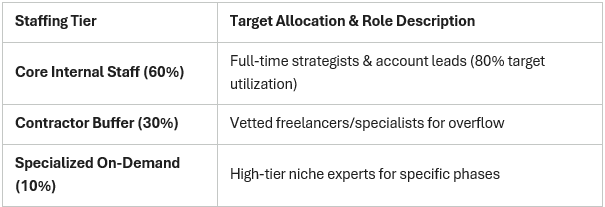
Using contractors as a flexible 30% buffer allows your agency to absorb new client accounts immediately without permanently inflating fixed payroll overhead.
Step 4: Implement SOW Safeguards to Kill Scope Creep
Scope creep is the silent killer of structuring agency profit margins. It happens when account managers accommodate "small extra requests," unbilled revision rounds, or extra strategy calls without updating client retainers.
To stop margin erosion:
- Define Out-of-Scope Pricing in the SOW: Every Statement of Work must explicitly outline deliverables, turnaround times, and maximum included revision rounds.
- Track Real-Time Account Margins: Measure actual team hours logged against each account monthly. If an account’s delivery margin drops below 50%, audit the cause immediately.
- Issue Formal Change Orders: Train account managers to respond to extra client requests with: "We’d love to help with that! That falls outside our core retainer, so here is a quick change order estimate for approval before we start."
The 30-Second Delivery Margin Audit
Run this quick 3-step audit to evaluate your agency's fulfillment efficiency:
- Calculate Monthly AGI: Total Client Invoices - Pass-Through Ad Spend & Software = AGI.
- Calculate Total Delivery Payroll: Production Staff Payroll + Freelance/Contractor Costs = Fulfillment Cost.
- Find Delivery Margin: (AGI- Fulfillment Cost) / AGI = Delivery Margin %.
If your delivery margin is below 50%, your fulfillment costs are consuming too much revenue, leaving your agency vulnerable to high overhead and razor-thin profits.
Conclusion
Structuring an agency for 30%+ delivery margins requires moving away from assumptions and adopting a disciplined financial model. By pricing retainers off fully burdened labor rates, controlling scope creep, and leveraging a flexible contractor mix, you can build a predictable, highly profitable marketing agency.
If you are ready to fix leaking project margins and want a clear path for how to increase agency profitability, our financial advisory team is here to help. We assist creative and digital agencies with unit economics, labor capacity modeling, and executive CFO strategy built for sustainable growth. Book a call to audit your current cost structures.

About The Author
Daniel Kaufman, is a CPA with over 20 years of experience helping businesses plan with confidence. He helps business owners understand their financial numbers and make smarter decisions for long-term growth. Daniel specializes in small business tax planning, setting up accounting systems, and is a QuickBooks ProAdvisor. He is passionate about giving business owners clarity and confidence through better financial insights.
FAQs
What is a good gross delivery margin for a digital marketing agency?

A healthy gross delivery margin for a digital agency should sit between 55% and 65% of Agency Gross Income (AGI). Maintaining this level ensures you have sufficient capital to cover fixed operating overhead (OpEx) while netting 25%+ at the bottom line.
How does scope creep impact agency profit margins?
Scope creep increases the unbilled labor hours spent on an account without increasing revenue. This inflates your cost-to-serve, drives down your effective hourly billable rate, and can quickly turn a high-margin client into an unprofitable account.
What is the difference between Gross Revenue and Agency Gross Income (AGI)?
Gross Revenue includes all incoming cash, including pass-through expenses like media ad spend and third-party software. AGI subtracts these pass-through costs to reflect the true revenue your agency earns for its fulfillment work. Financial metrics should always be calculated against AGI.
What target billable utilization rate should agency production teams maintain?
Full-time production staff (designers, developers, strategists) should aim for a 70% to 80% billable utilization rate (~28–32 hours per week billed to client accounts). Account directors and managers typically target 50% to 60% due to internal administrative duties.
When should an agency switch from hourly billing to retainer pricing?
Agencies should transition to retainer models as early as possible, once standard service workflows are established. Retainers provide predictable monthly cash flow, eliminate penalties for working efficiently, and allow you to price based on delivered value rather than time spent.
Read More Blogs

HVAC Business Valuation Multipliers: How Buyers Value Mechanical Contracting Firms
Bookkeeper vs Fractional CFO: Which Financial Advisory Does Your Business Need?

Connect with our experienced CFO advisory team
Get Insights
Submit the contact form to receive tailored financial insights and practical guidance from our team
Seamless Experience
Share your needs through the form for quick responses and smooth onboarding support.
Pricing That Makes Sense
After reviewing your inquiry, we provide transparent, practical pricing aligned with your business's financial needs.