
Bookkeeper vs Fractional CFO: Which Financial Advisory Does Your Business Need?
✅ Information Verified by a CPA




Many business owners reach a frustrating growth plateau, sales are climbing, project schedules are packed, and cash in the bank is dangerously tight. When unexpected tax bills hit or project profit margins shrink, the default reaction is usually, "I need a better accountant."
However, the core issue often isn't a bad accountant, it's expecting transactional bookkeeping to solve strategic financial problems. Understanding the difference in a bookkeeper vs fractional CFO comparison is the single most important step toward building a business that generates predictable profit rather than endless operational stress.
What Does a Bookkeeper Do?
A bookkeeper manages historical financial data. Their primary goal is accuracy, compliance, and organization, ensuring every dollar coming in and going out is categorized properly.
Standard HVAC company bookkeeping or creative agency data entry includes:
- Recording day-to-day transactions (bills, receipts, customer payments).
- Reconciling bank accounts and credit card statements.
- Processing employee payroll and managing accounts payable/receivable.
- Generating basic monthly reports like Profit &Loss (P&L) statements and balance sheets.
The Limitation: A bookkeeper tells you where your money went. They cannot tell you where your money should go, how to fix shrinking gross margins, or how much cash you will have in bank accounts 90days from now.
2. What Does a Fractional CFO Do?
A fractional CFO is an executive-level financial strategist who works with your business on apart-time or contract basis. They do look after the compliance and, focuses on future growth, cash liquidity, and profitability.
Key responsibilities of a fractional CFO include:
- Forward-Looking Forecasting: Building 13-week rolling cash flow models to prevent surprise liquidity pinches during off-peak or shoulder seasons.
- Unit Economics & Pricing Optimization: Analyzing project-level delivery margins for digital agencies or job-costing metrics for trade contractors.
- Capital Allocation &Valuation: Structuring business finances to clean up balance sheets, eliminate owner dependence, and drive increasing mechanical contractor value or agency enterprise multipliers.
- Strategic Decision Support: Evaluating whether to buy equipment, expand headcount, change pricing tiers, or take on debt.
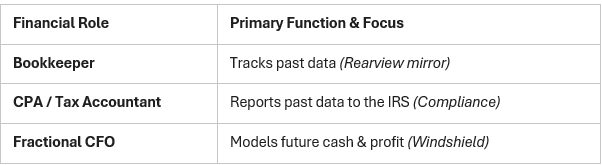
Bookkeeper vs. Fractional CFO
To evaluate which level of financial advisory services your company requires, look at how each role operates across core business functions:
Primary Focus
Bookkeeper (Data Collection & Categorization):
- What they do: Ensures that every single financial transaction, vendor bills, client payments, credit card receipts, and bank fees, is recorded accurately and assigned to the correct chart of accounts.
- The Goal: Operational compliance and tax readiness. They ensure your books balance down to the penny, so you don't face penalties or messy audits.
Fractional CFO (Data Interpretation & Strategy):
- What they do: Takes the raw, organized numbers provided by the bookkeeper and translates them into actionable business strategy. They evaluate unit economics, analyze profit leaks, and design financial frameworks to scale the business.
- The Goal: Enterprise value creation and cash optimization. They focus on turning your operating model into a predictable, high-margin asset.
Time Horizon
Bookkeeper (Historical):
- Perspective: Operates entirely in the past. Their work begins after money has already been spent or received.
- Focus Area: Closing out last month’s books, verifying historical receipts, and generating historical financial statements (Profit & Loss, Balance Sheet, Cash Flow Statement).
Fractional CFO (Forward-Looking / Predictive):
- Perspective: Operates in the present and future. They treat historical data merely as a baseline to predict what will happen next.
- Focus Area: Building 13-week rolling cash flow forecasts, multi-year growth projections, and scenario plans (e.g., "What happens to our bank balance if we hire2 engineers next month or if a major client churns?").
Core Deliverables & Output
Bookkeeper (Standard Financial Statements):
- Reconciled Ledgers: Clean, categorized QuickBooks or Xero accounting records with zero missing items.
- Standard Compliance Reports: Monthly P&L statements, balance sheets, accounts payable (A/P) aging reports, and accounts receivable (A/R) aging reports.
Fractional CFO (Custom Strategic Dashboards):
- 13-Week Cash Flow Models: Granular tools that map out exact cash inflows and outflows to prevent sudden liquidity crunches.
- Custom KPI Dashboards: Executive-level metrics such as Agency Gross Income (AGI), Delivery Margins, Customer Acquisition Cost (CAC) vs. Lifetime Value (LTV), and Work-in-Progress(WIP) adjustment models.
- Capital Allocation Frameworks: Debt restructuring plans, equity partner buy-in calculations, and equipment purchase/financing evaluations.
Pricing & Margin Role
Bookkeeper (Passive Processing):
- Role: Inputs invoices and records customer payments exactly as written in client contracts or sales orders.
- Impact: They do not question whether a job was priced profitably, whether labor hours ran over budget, or if a client retainer is losing money—they simply record thetransaction.
Fractional CFO (Active Optimization):
- Role: Analyzes job costing and activity-based profitability to identify which clients or service lines are driving net income.
- Impact: Re-engineers pricing models (e.g., shifting an agency from hourly rates to high-margin tiered retainers, or adjusting an HVAC contractor's labor burden rates) to ensure every deal closed hits a target gross margin (e.g., 55%+delivery margin).
Business Value & Financial Impact
Bookkeeper (Necessary Cost Center / Operational Overhead):
- Value Proposition: Keeps the business organized, compliant with tax laws, and safe from IRS penalties or employee payroll errors.
- ROI Metric: Cost efficiency and error prevention, saving the founder time spent on tedious administrative work.
Fractional CFO (Profit Center / Growth Driver):
- Value Proposition: Identifies trapped cash in working capital, eliminates waste, prevents bad hiring/investing decisions, and systematically increases net profit margins.
- ROI Metric: Directly measurable return, increasing bottom-line net profit by 5%–15%,securing better credit terms, or expanding business valuation multiples prior to an exit or M&A deal.
4. Which Financial Partner Does Your Business Need Right Now?
Choosing between these roles depends on your revenue scale, operational complexity, and growth goals.
You Need a Bookkeeper If:
- Your annual revenue is under $500,000 with simple operational workflows.
- Your primary challenge is organizing receipts, staying on top of invoicing, and getting clean numbers ready for your tax CPA.
- Your business model is straightforward with predictable expenses and minimal inventory/payroll complexity.
You Need a Fractional CFO If:
- Your annual revenue sits between $1M and $15M and you are scaling rapidly.
- You are experiencing a "cash crunch" despite record high sales figures.
- You manage complex operations, such as an agency tracking AGI and delivery margins, or an HVAC contractor navigating WIP reports and equipment terms.
- You are preparing for a major trigger event: bringing on an equity partner, securing credit lines, or preparing for a lucrative exit.
The 30-Second Self-Diagnostic Audit
Run this quick three-question diagnostic to see if your current setup is leaking cash:
- Do you know your projected bank balance 8 weeks from today based on upcoming payroll, material costs, and receivables?
- Can you identify your single most unprofitable client or service line using exact internal labor costs?
- When you review monthly financials with your team, do you spend 90% of the time discussing future growth strategies rather than past expenses?
If you answered "No" to two or more of these questions, your business has outgrown basic record-keeping and requires strategic leadership.
Conclusion
A bookkeeper and a fractional CFO are not rivals, they are complementary partners. A fractional CFO relies on the clean data provided by a meticulous bookkeeper to build accurate models, while the bookkeeper relies on the CFO to design accounting processes that support long-term goals.
If your business is generating solid revenue but struggling to keep cash in the bank, it's time to upgrade your financial model. Our specialized financial advisory team helps fast-growing companies clean up complex accounting, install 13-week cash forecasting systems, and optimize profit margins. Book a call with Atheneum CFO to get a proactive financial diagnostic for your business.

About The Author
Daniel Kaufman, is a CPA with over 20 years of experience helping businesses plan with confidence. He helps business owners understand their financial numbers and make smarter decisions for long-term growth. Daniel specializes in small business tax planning, setting up accounting systems, and is a QuickBooks ProAdvisor. He is passionate about giving business owners clarity and confidence through better financial insights.
FAQs
What is the typical fractional CFO cost compared toa full-time CFO?

A full-time CFO typically commands a base salary of $250,000 to $350,000+ per year, plus equity, performance bonuses, and executive benefits. An outsourced CFO engagement generally ranges between $3,000 and $8,500 per month, delivering high-level strategic direction at a fraction of full-time executive overhead.
Can my CPA handle the duties of a fractional CFO?
While tax CPAs provide vital compliance services, their primary focus is reporting historical data to minimize tax liabilities. Most CPAs do not manage daily operational cash flow, track employee utilization, optimize pricing tiers, or build forward-looking operational models.
What is the main difference in a fractional CFO vs CPA comparison?
A CPA focuses on tax strategy, regulatory compliance, and historical reporting (looking backward). A Fractional CFO focuses on operational cash flow, profit margin optimization, scenario planning, and driving enterprise value (looking forward).
How do I know when to hire a fractional CFO for mybusiness?
Knowing when to hire a fractional CFO usually comes down to specific trigger events: rapid revenue growth paired with cash pinches, expanding beyond $1M+ in revenue, launching new service lines, navigating shoulder-season drops, or preparing for an M&A exit.
Does a fractional CFO replace my existing bookkeeper or accountant?
A fractional CFO works alongside your existing bookkeeping and tax team. They elevate the data provided by your bookkeeper to make strategic, forward-looking business decisions that maximize net margins.
Read More Blogs


HVAC Business Valuation Multipliers: How Buyers Value Mechanical Contracting Firms

Connect with our experienced CFO advisory team
Get Insights
Submit the contact form to receive tailored financial insights and practical guidance from our team
Seamless Experience
Share your needs through the form for quick responses and smooth onboarding support.
Pricing That Makes Sense
After reviewing your inquiry, we provide transparent, practical pricing aligned with your business's financial needs.