
HVAC Business Valuation Multipliers: How Buyers Value Mechanical Contracting Firms
✅ Information Verified by a CPA





Mechanical and HVAC contracting owners believe that hitting a major revenue milestone, like $5 million or $10 million in annual top-line sales, automatically guarantees a massive payday when it's time to sell. However, entering private equity or M&A acquisition negotiations with a focus solely on top-line revenue often leads to a harsh reality check.
Sophisticated private equity buyers, roll-up aggregators, and strategic competitors do not purchase revenue, they purchase predictable future cash flow. Learning how to value an HVAC business requires understanding how buyers calculate adjusted earnings and apply valuation multipliers to determine your firm's true enterprise value.
The Valuation Reality
In the mechanical contracting industry, business value is calculated using a straightforward core formula:
Enterprise Value =Adjusted Cash Flow × Valuation Multiplier
Let’s say, two HVAC companies generate $8 million in annual revenue, one may sell for 3.5x earnings while the other commands a premium 7.0x multiple. The difference between a $3 million exit and a $7 million exit rarely lies in sales volume, it depends entirely on operational quality, recurring revenue stability, and financial transparency.
SDE vs. EBITDA
When evaluating an HVAC company valuation, buyers use one of two primary cash flow metrics depending on the size and structure of your business.
Seller’s Discretionary Earnings (SDE)
- Target Size: Typically used for smaller, owner-operated shops generating under $3 million in gross revenue.
- Definition: SDE measures the total financial benefit a single full-time owner-operator derives from the business. It takes net income and adds back the owner's salary, owner perks, personal vehicle leases, and non-recurring expenses.
- Typical Multiples: SDE multiples generally range between 2.0x and 3.5x.
Adjusted EBITDA
- Target Size: Used by private equity groups, family offices, and institutional buyers for middle-market contractors generating $3 million to $20+ million in revenue.
- Definition: Earnings Before Interest, Taxes, Depreciation, and Amortization—adjusted for normalized market-rate management salaries and true operational valuation add-backs.
- Typical Multiples: EBITDA multiples range broadly from 4.0x to 8.0x+ depending on scale and operational maturity.
The Valuation Spectrum: How HVAC Companies Are Rated
Understanding where your business sits on the valuation spectrum allows you to make strategic adjustments years before going to market:
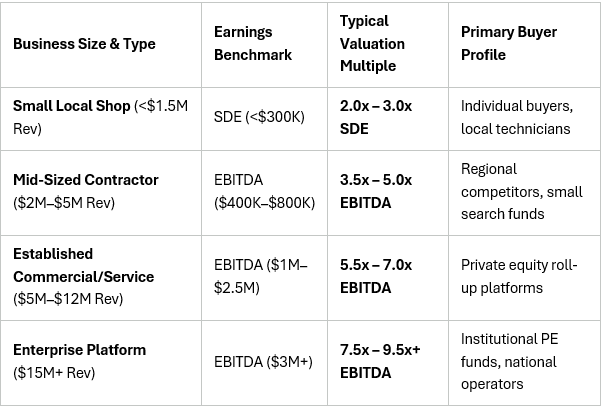
The 5 Drivers That Expand Your HVAC EBITDA Multiplier
If you want to move your business from the lower end of the valuation spectrum to a premium multiplier, you must systematically de-risk the enterprise for a prospective buyer. A robust HVAC business valuation blueprint focuses on five key levers:
A. High Percentage of Recurring Service Agreement Revenue
Buyers pay top dollar for predictability. A firm with 30%+ of its gross margin locked into annual preventive maintenance contracts (commercial or residential agreements) commands a significantly higher EBITDA multiplier HVAC than a shop relying entirely on emergency change-outs or low-margin new construction bids.
B. Balanced Commercial vs. Residential Mix
Understanding commercial vs residential HVAC valuation dynamics is critical. While residential service offers high gross margins, commercial maintenance agreements offer long-term stability and higher average order values. A diversified customer base prevents reliance on any single general contractor or developer.
C. Shift from Cash Accounting to Accrual Accounting
One of the fastest ways to destroy buyer trust during M&A due diligence is presenting messy, cash-basis financials. Business buyers require strict accrual accounting vs cash accounting statements to track earned revenue against actual material expenses, labor costs, and deferred maintenance liabilities.
D. Strong Management Team (Zero Owner Dependence)
If the owner is still running service calls, estimating major commercial bids, or personally holding all customer relationships, the business carries extreme "key-person risk. "Companies with a capable general manager, lead estimators, and a middle-management layer trade at the highest multiples.
E. Clean Equipment Fleet and Digital Systems
Modern buyers look closely at field service management (FSM) software integration, GPS fleet tracking, and average vehicle age. A well-maintained fleet with clean titles and integrated digital workflows reduces immediate post-sale capital expenditure requirements for the buyer.
Red Flags That Shrink Valuation Multipliers Immediately
Even if your EBITDA looks impressive on paper, buyers will apply severe purchase price discounts or require high escrow holdbacks if they uncover these operational red flags:
- High Customer Concentration: Having a single commercial client or general contractor account for more than15% to 20% of your total revenue.
- Unrecorded Warranty &Deferred Liabilities: Failing to track unearned maintenance contract deposits as liabilities on the balance sheet.
- Inaccurate Job Costing: Lacking labor burden tracking, leading to inconsistent gross margins across install and service divisions.
- High Technician Churn: Excessive employee turnover in a competitive skilled-trades labor market.
The 30-Second Valuation Readiness Audit
Run this quick 4-step diagnostic to evaluate if your mechanical contracting business is structured for a premium exit:
- Step 1: Do maintenance contract renewals generate at least 20% of your annual gross profit?
- Step 2: Is your business running on accrual-based accounting with monthly WIP(Work-in-Progress) reporting?
- Step 3: Could you take a 30-day vacation without sales dropping or field operations grinding to a halt?
- Step 4: Are all non-operational owner expenses documented and ready for legal earnings normalization (add-backs)?
-
If you answered "No" to two or more of these questions, your company is currently trading at a discounted valuation multiple.
Conclusion
Maximizing your company’s enterprise value is not something you do 30 days before listing with a broker, it is a multi-year engineering process. By transitioning to accrual accounting, building recurring maintenance agreements, and eliminating owner dependence, you can systematically expand your valuation multiple and protect your hard-earned equity.
If you want to know what your business is worth today and need a clear roadmap for increasing mechanical contractor value, our specialized financial advisory team is here to help. We assist mechanical and trade contractors with earnings normalization, accrual accounting transitions, and strategic CFO guidance built for high-value exits. Book a call to audit your valuation readiness.

About The Author
Daniel Kaufman, is a CPA with over 20 years of experience helping businesses plan with confidence. He helps business owners understand their financial numbers and make smarter decisions for long-term growth. Daniel specializes in small business tax planning, setting up accounting systems, and is a QuickBooks ProAdvisor. He is passionate about giving business owners clarity and confidence through better financial insights.
FAQs
What is the average EBITDA multiplier for an HVAC business?

The average EBITDA multiple for small to mid-sized HVAC companies typically ranges between 3.5x and 5.5x. However, larger platform companies ($2M+ in EBITDA) with high recurring contract revenue and strong middle management can command multiples between 6.5x and 8.5x+.
How do maintenance agreements impact an HVAC company valuation?
Service maintenance agreements directly increase valuation because they represent predictable, recurring revenue with high retention rates. Buyers view contract-backed revenue as significantly lower risk than one-off emergency repairs or competitive project bids, leading to higher valuation multiples.
What are typical valuation add-backs for an HVAC contractor?
Common add-backs include owner compensation above market rate, personal vehicle leases, family member salaries on payroll not involved in daily operations, one-time legal/consulting fees, and non-operational personal expenses run through the business.
Why do private equity buyers prefer commercial service over residential new construction?
New construction revenue is tied to macro economic real estate cycles and often suffers from tight margins, delayed retainage payments, and high bidding competition. Commercial service and maintenance contracts provide consistent, high-margin cash flow regardless of broader economic downturns.
When should an HVAC contractor start preparing for a business sale?
Contractors should begin financial and operational preparation 2 to 3 years before their target exit date. This timeframe allows enough room to transition from cash to accrual accounting, clean up balance sheets, build out middle management, and demonstrate multi-year growth trends.
Read More Blogs


Bookkeeper vs Fractional CFO: Which Financial Advisory Does Your Business Need?

Connect with our experienced CFO advisory team
Get Insights
Submit the contact form to receive tailored financial insights and practical guidance from our team
Seamless Experience
Share your needs through the form for quick responses and smooth onboarding support.
Pricing That Makes Sense
After reviewing your inquiry, we provide transparent, practical pricing aligned with your business's financial needs.