
What Does a Fractional CFO Actually Do? Core Services & Key Deliverables
✅ Information Verified by a CPA





When small-to-medium business owners look into fractional CFO services, they ask where the line is drawn between their current accounting setup and high-level executive strategy. If your bookkeeper categorizes daily transactions and your CPA files your taxes every spring, what does a fractional CFO handle on a week-to-week basis?
A fractional CFO designs and manages the financial strategy for your company. They turn accounting data into forward-looking operational plans, ensuring every hiring decision, capital investment, pricing change, and credit facility supports long-term profitability and spendable cash flow. Here is a breakdown of the core services, strategic functions, and key deliverables a fractional CFO installs in a growing business.
Strategic Financial Planning & Analysis (FP&A)
Financial Planning & Analysis (FP&A) forms the foundation of fractional CFO services. Rather than looking backward at last month’s performance, FP&A builds models that predict future outcomes based on actual operational drivers.
[Accounting Inputs] ➔ [Driver-Based Financial Models] ➔ [Cash & Margin Tracking]
13-Week Rolling Cash Flow Forecast
A week-by-week schedule of the exact cash moving in and out of your bank accounts over the next three months. This activity forecast maps out realistic collection dates against your mandatory cash outflows like weekly payroll, recurring vendor bills, tax instalments, and loan payments.
Profit on a P&L statement does not equal cash in the bank. A 13-week forecast gives you an early-warning radar system. If a $50,000 cash deficit is looming six weeks from today due to slow-paying clients, you have plenty of time to draw on a credit line, delay non-essential spending, or speed up invoice collections, avoiding a payroll crisis.
Multi-Year Three-Statement Models
This is a dynamic financial simulator that links your Income Statement (profit and loss), Cash Flow Statement (cash timing), and Balance Sheet (assets, debt, and net worth) into a single cohesive model.
Sine the three statements are connected, a change in one automatically updates the others. If you model hiring five senior engineers in Q3, the system instantly shows you the increased payroll expense on your Income Statement, the reduced cash reserve on your Cash Flow Statement, and the shifting liability ratios on your Balance Sheet.
It acts as a financial flight simulator. Before committing real capital to open a second location or purchase heavy equipment, you can test the decision on paper first to see how it impacts your cash reserves and debt limits over the next three to five years.
Bottom-Up Budgeting Framework
A budgeting method that builds your revenue and expense targets from actual operational capacity, rather than starting with a random top-line goal. This framework looks at ground-level reality: How many leads can your marketing budget generate? How many sales calls can your current team make? What is your actual conversion rate and fulfilment capacity?
It prevents you from setting impossible revenue targets. By tying financial projections to operational activities, you control, your team gets a realistic, actionable roadmap to hit its growth goals.
Scenario & Variance Analysis
This is a monthly reality check that compares your projected financial model against what happened in your bank accounts and accounting system. At the end of each month, you place your forecasted numbers next to your actual results. Variance analysis flags where you missed or exceeded targets (e.g., "Ad spend was 15% higher than budgeted, but sales were down 8%"). Scenario analysis lets you test "what-if" situations based on those gaps(e.g., "What if sales stay down 8% for another six months?").
No financial forecast is 100% accurate. Comparing expectations against reality every 30 days lets leadership catch negative trends early, reallocate resources quickly, and make informed adjustments before small operational leaks turn into major cash deficits.
Operational Metrics & Margin Optimization
Increasing top-line revenue delivers little value if hidden costs absorb your bottom-line profits. A fractional CFO analyzes unit economics across your organization to ensure expanding sales volume leads to genuine profit margin expansion.
Key Deliverables & Systems:
- Executive KPI Dashboard: Real-time visual dashboards that track core metrics—such as Customer Acquisition Cost (CAC), Lifetime Value (LTV), gross margin per project, customer retention, and debt service coverage ratios.
- Profitability Audits: Deep-dive reviews into client accounts, product lines, or service packages to spot unexpected cost drivers, low-margin deliverables, or unused software subscriptions that drain cash.
- Pricing Model & Contract Restructuring: Updated pricing tiers, hourly rates, and retainer payment terms that account for rising labor costs and inflation, ensuring every sales agreement protects gross profit margins.
- Working Capital Management: Analyzing inventory turnover rates and Days Sales Outstanding (DSO) to accelerate invoice collections and negotiate better payment terms with suppliers.
Growth Capital Strategy & Executive Support
When a business reaches a major decision point, such as applying for a commercial credit line, raising investor capital, or negotiating a major contract the CFO leads the financial management side of the business. This includes following:
Bank Under writing Packages & Credit Line Negotiation: Preparing commercial loan packages, presenting financial models directly to bank loan officers, and securing revolving lines of credit with favourable terms.
Investor Data Rooms & Pitch Preparation: Building investor-ready financial presentations, managing financial due diligence requests, and building valuation models during equity funding rounds.
M&A Preparation & Exit Planning: Conducting buy-side or sell-side financial due diligence, analysing deal valuation multiples, organizing historical records, and modelling post-acquisition integration costs.
Board & Leadership Reporting: Executive-level financial reporting packages designed for business partners, advisory boards, and key stakeholders.
Financial Controls, Governance, and Systems Oversight
A fractional CFO does not replace your internal bookkeeper or external CPA. They provide executive oversight, managing the accounting infrastructure, enforcing internal controls, and mitigating financial risk.
- Accounting Team Leadership & Month-End Close Management: Directing internal bookkeepers and controllers to ensure monthly book closes are completed accurately by the 10th of each month.
- Internal Control Workflows: Installing multi-person approval workflows, payment threshold limits, and fraud prevention measures to safeguard company assets and bank accounts.
- Software Stack Integration: Evaluating and implementing specialized financial software, such as automated invoicing tools, reporting engines, and inventory management systems that connect directly with your core accounting platform.
- Proactive Tax Strategy Alignment: Working with your tax CPA throughout the year to execute strategies, such as Section 179 asset deductions, R&D credits, and entity optimizations.
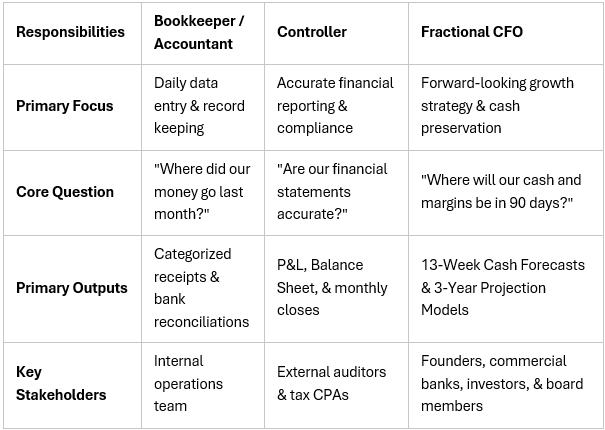
Comparing Financial Leadership Roles
To understand how a fractional CFO fits into your organization, compare their responsibilities against traditional accounting roles:
Conclusion
Adding a fractional CFO moves your business away from reactive decision-making and into a structured, data-driven financial operation. By installing cash forecasts, optimizing gross margins, and building bank-ready financial models, a finance partner gives you clear visibility over your company's growth.
Ready to install executive financial leadership in your business? Schedule a strategy call with Atheneum CFO today to see how our fractional CFO services can protect your liquidity and grow your net profits.

About The Author
Daniel Kaufman, is a CPA with over 20 years of experience helping businesses plan with confidence. He helps business owners understand their financial numbers and make smarter decisions for long-term growth. Daniel specializes in small business tax planning, setting up accounting systems, and is a QuickBooks ProAdvisor. He is passionate about giving business owners clarity and confidence through better financial insights.
FAQs
How many hours a week does a fractional CFO spend working on my business?

Depending on your company’s size and scope, engagement levels typically range from 5 to 20 hours per month. Hours scale up during active projects, such as securing bank financing, software implementations, or M&A preparation and return to baseline during standard operational months.
Will a fractional CFO manage my company's daily invoicing or bill pay?
No. Daily operational tasks like issuing invoices, paying vendor bills, running payroll, and categorizing receipts are handled by your internal bookkeeper or office manager. The fractional CFO establishes approval systems and uses accounting outputs to guide executive strategy.
What accounting software systems does a fractional CFO work with?
Most fractional CFOs work across standard cloud accounting platforms like QuickBooks Online, Xero, and Sage, as well as enterprise ERPs like NetSuite. They also integrate specialized reporting engines, BI tools, and automated cash forecasting software into your existing setup.
How does a fractional CFO interact with my existing tax CPA?
Your tax CPA handles annual tax filing andstatutory compliance. A fractional CFO works with your CPA throughout the year,using forward-looking financial models to ensure major equipment purchases,inventory moves, and owner distributions are structured for optimal taxefficiency.
How long do fractional CFO engagements usually last?
Because fractional CFO services support ongoing operational growth, most client relationships run as long-term monthly partnerships lasting 12 to 36+ months. Some engagements transition when a company grows large enough ($25M+ revenue) to hire a full-time executive CFO.
Read More Blogs



Connect with our experienced CFO advisory team
Get Insights
Submit the contact form to receive tailored financial insights and practical guidance from our team
Seamless Experience
Share your needs through the form for quick responses and smooth onboarding support.
Pricing That Makes Sense
After reviewing your inquiry, we provide transparent, practical pricing aligned with your business's financial needs.