
5 Critical Signs Your Business Has Outgrown Its Controller or CPA
✅ Information Verified by a CPA





When founding an SMB, your early financial team usually consists of an external tax CPA and an internal bookkeeper or controller. For early-stage operations, this setup works well. Accounting systems designed for historical compliance cannot provide forward-looking strategic oversight.
Relying solely on a controller or CPA to guide major expansion, manage working capital, or structure capital raises often leaves leadership making critical executive choices in the dark. Here are the five critical signs that your company has outgrown its controller or CPA, along with the precise strategic framework needed to transition into executive financial leadership.
You Are Experiencing Rapid Revenue Growth Without Increasing Profit
One of the most frustrating experiences for a growing founder is seeing top-line revenue hit record highs month after month while net spendable cash and profit margins remain flat, or worse, shrink.
When revenue expands, operational overhead, payroll costs, vendor commitments, and delivery complexity expand alongside it. If your gross profit margins are not protected, additional sales volume simply magnifies underlying operational inefficiencies.
The Difference Between CPA Compliance and CFO Strategy
A traditional CPA or controller looks backward. They summarize what happened over the past 30, 60, or 90 days, producing standard Income Statements that group costs into broad categories.
- The CPA/Controller View: "Your revenue was $500,000 last month, and your total operating expenses were $450,000, leaving a net income of $50,000."
- The CFO Strategic View: "While top-line revenue grew by 20%, your direct labour delivery costs increased by32% due to project overtime. Client Cohort A generates a 65% gross margin, but Client Cohort C operates at a 4% loss after accounting for account management hours. We need to restructure our pricing model and phase out low-margin service agreements."
When top-line growth fails to yield bottom-line profits, you do not have an accounting issue; you have a unit economics and margin optimization issue. Resolving it requires a strategic CFO who can audit cost structures, redesign contract terms, and align sales targets with net profitability.
Cash Flow Instability Is Hindering Daily Operations
A company can show strong net profits on paper and still face severe liquidity crises. If you regularly struggle to cover payroll, delay vendor payments, or stress over timing differences between paying expenses and collecting invoices, your financial management model is failing to protect your liquidity.
Controllers and CPAs track cash movements after transactions clear the bank. Traditional Bookkeeping record the bills paid and the deposits received, but they rarely model future cash timing.
[Bookkeeping] ➔ LooksBackward ➔ Measures Past Profit (P&L)
[Strategic Cash Forecasting] ➔ LooksForward ➔ Tracks Future Cash Timing
To eliminate cash flow volatility, leadership must transition from backward-looking monthly P&Ls to a forward-looking 13-week rolling cashflow forecast.
A CFO builds cash forecasting models that map exact timing variables:
- Collection Cycles: Tracking real-world Days Sales Outstanding (DSO) rather than assumed payment terms.
- Obligation Mapping: Aligning weekly customer collections against non-negotiable cash outflows, including payroll runs, vendor bills, inventory purchases, debt service, and tax instalments.
- Scenario Planning: Stress-testing cash reserves against potential delays, such as a major client extending payment from 30 days to 60 days.
By identifying cash shortfalls 6 to 12 weeks before they occur, executive financial leadership gives you the runway needed to draw on credit lines, adjust payment timing, or accelerate collections, turning cash management from a daily panic into a predictable routine.
You Are Preparing to Raise Capital, Secure Loans, or Sell
When a business reaches a major growth juncture, such as applying for a $2M commercial credit line, bringing on private equity investment, or preparing for an acquisition, the financial scrutiny from external parties increases dramatically.
Lenders, investors, and acquirers evaluate risk differently than internal teams. They expect sophisticated, interconnected financial modeling that proves the company can manage capital responsibly and deliver sustainable returns.
Structuring Financial Models for Investor and Lender Due Diligence
A controller or tax CPA is rarely trained to lead complex capital raises or M&A transactions. Handing a prospective lender or investor a basic QuickBooks P&L printout often damages credibility and leads to unfavorable terms or flat rejections.
A CFO prepares your organization for due diligence by delivering bank- and investor-ready systems:
- Three-Statement Financial Models: Connecting the Income Statement, Cash Flow Statement, and Balance Sheet so that operational shifts automatically update cash positions and solvency ratios.
- Quality of Earnings (Q of E) Preparation: Auditing historical financials to clean up personal owner expenses, normalize non-recurring items, and present clear EBITDA metrics.
- Debt Service Coverage Ratio (DSCR) Modelling: Proving to commercial bank underwriting teams that your cash flow can comfortably support debt service payments under various stress-tested scenarios.
Leadership Lacks Real-Time Visibility into Unit Economics
As a business grows, relying on standard month-end financial packages, delivered 20 to 30 days after the month closes is like trying to drive a car while only looking in the rearview mirror. By the time you notice a spike in customer acquisition costs or a drop in project profitability, weeks of cash have already been lost.
Standard controllers focus on financial compliance rather than operational key performance indicators (KPIs). They group expenses into general categories like "Marketing" or "Payroll" without connecting those dollars to operational outcomes.
Why Standard Monthly Financial Statements Aren’t Enough
Executive decision-making requires real-time visibility into the underlying drivers of your business model. A CFO builds custom KPI dashboards that track unit economics dynamically:
- Customer Acquisition Cost (CAC) vs. Lifetime Value (LTV): Measuring exact payback periods to ensure marketing and sales spend yield healthy returns.
- Gross Margin per Product/Service Line: Breaking down direct labour, raw materials, and fulfilment overhead to isolate true unit profitability.
- Capacity Utilization Rates: Tracking billable efficiency across delivery teams to determine the exact headcount needed before taking on new client contracts.
- Contribution Margin: Calculating the spendable margin each sales dollar contributes toward fixed operational overhead.
Complex Multi-Entity or Multi-State Taxes Are Straining Resources
Scaling past $2M often introduces organizational complexity: launching subsidiary entities, opening facilities in multiple states, hiring remote workers across state lines, or managing international supply chains.
With this expansion comes an intricate web of state nexus rules, payroll tax registrations, transfer pricing considerations, and corporate entity structures.
If your financial team lacks high-level coordination, your company faces severe risk, either overpaying on corporate taxes due to inefficient structuring or incurring steep regulatory penalties for non-compliance.
Aligning CFO Growth Strategy with CPA Tax Execution
It is essential to understand where the responsibilities of a tax CPA end and those of a CFO begin:
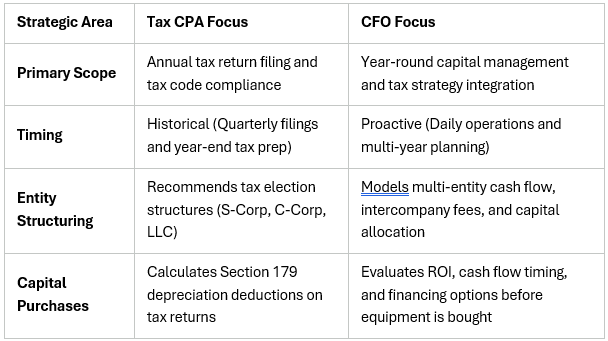
A CFO does not replace your tax CPA. They act as the internal executive lead who coordinates with your CPA year-round. They ensure that equipment investments, owner distributions, and entity adjustments are executed proactively, maximizing operational liquidity while minimizing legal tax obligations.
Conclusion
Outgrowing your controller or CPA is a natural byproduct of business success. It simply signals that your company has reached a level of operational scale where basic compliance and historical accounting are no longer enough to sustain growth.
Installing fractional CFO leadership gives your organization high-level strategic oversight, dynamic cash flow forecasting, and bank-ready financial modelling, delivering executive-level guidance tailored to your growth trajectory. Book a free call with Atheneum CFO today to discover how our fractional CFO services protects the liquidity and fuel your next phase of growth.

About The Author
Daniel Kaufman, is a CPA with over 20 years of experience helping businesses plan with confidence. He helps business owners understand their financial numbers and make smarter decisions for long-term growth. Daniel specializes in small business tax planning, setting up accounting systems, and is a QuickBooks ProAdvisor. He is passionate about giving business owners clarity and confidence through better financial insights.
FAQs
What is the main difference between a Controller and a Fractional CFO?

A Controller focuses on historical accuracy, compliance, bookkeeping oversight, and closing the monthly books. A Fractional CFO focuses on the future, using financial data to build multi-year projection models, manage cash flow timing, optimize gross margins, structure capital raises, and guide strategic growth.
Should I replace my current bookkeeper or CPA if Ihire a Fractional CFO?
No. A Fractional CFO works alongside your existing team. Your bookkeeper manages daily data entry, your controller ensures accurate financial statements, and your external CPA files annual tax returns. The Fractional CFO leads the team, using their financial outputs to guide high-level strategy.
At what revenue threshold does a business usually outgrow its controller?
Most small-to-medium businesses start feeling the need for executive financial leadership as they approach or pass $2M to $5M in annual revenue. At this stage, working capital demands increase, payroll expenses expand, and pricing decisions require deep financial modelling.
How does a Fractional CFO help stabilize cash flow?
A Fractional CFO replaces static, backward-looking accounting reports with a dynamic 13-week rolling cash flow forecast. This model tracks the exact timing of customer collections against mandatory vendor bills, payroll runs, and debt payments, allowing you to catch and resolve cash deficits weeks in advance.
How much does it cost to bring on a Fractional CFO compared to hiring full-time?
A full-time executive CFO typically costs between $350,000 and $500,000+ per year when accounting for base salary, executive benefits, bonuses, and equity grants. A Fractional CFO provides the same high-level strategic oversight through a flexible monthly retainer, ranging from $3,000 to $8,000 per month.
Read More Blogs

What Is a Business Finance Partner and Why Does Your Growing Company Need One?
The Strategic Planning Process: How CFOs Build Multi-Year Growth Strategies

How to Build Accurate Financial Projections for Your Business Growth Plan
Connect with our experienced CFO advisory team
Get Insights
Submit the contact form to receive tailored financial insights and practical guidance from our team
Seamless Experience
Share your needs through the form for quick responses and smooth onboarding support.
Pricing That Makes Sense
After reviewing your inquiry, we provide transparent, practical pricing aligned with your business's financial needs.