
What is PTET? A Multi-State Tax Guide for Business Owners
✅ Information Verified by a CPA




Many small business owners faced a major tax spike when a new federal law capped the individual deduction for State and Local Taxes, known as the SALT deduction, at 10,000 dollars. If you live in a state with high income taxes, you likely found yourself unable to write off a massive portion of the state taxes you paid on your business earnings. Your federal tax bill jumped simply because your business income passed directly onto your personal tax return.
To solve this widespread problem, state governments stepped in with a clever solution called the Pass-Through Entity Tax, or PTET. This tax mechanism acts as a completely legal state and local tax workaround. It allows partnerships, LLCs, and S Corporations to pay state income taxes directly at the company level rather than passing that burden to the owners. By shifting the tax payment to the business, you can bypass the personal $10,000 cap and unlock substantial savings on your federal return. Let’s understand the SALT concept in detail!
How the Pass-Through Entity Tax Works
An LLC or S Corporation does not pay federal or state income tax itself. The net profit passes through to your personal tax return via a Schedule K-1. You then owe state and federal income tax on that money as an individual. When you file your personal federal return, your deduction for those state taxes hits the $10,000 ceiling, leaving the rest completely undeductible.
[ Business Income ] ──► [ Pays State PTET directly ] ──► Deductible Business Expense
└──► Lowers Federal Taxable Income
When your business makes a PTE election, the entire dynamic changes. Your company chooses to file a special tax return and pays the state income tax on its net earnings directly out of the business bank account. Because a business entity is paying the tax, the IRS treats the payment as a regular, fully deductible business expense. This deduction lowers the net business income reported to the federal government, which automatically shrinks your federal tax bill.
To ensure you do not pay the same tax twice, your state provides an individual state tax credit or income exclusion on your personal return. When you file your personal state tax form, you use this credit to offset the state taxes you would have owed on your business income.
Measuring the Federal Tax Savings for Businesses
The financial impact of a PTET election can add up to thousands of dollars in annual savings. Consider a straight forward scenario for a small business owner who runs an S Corporation with 200,000 dollars in net annual profit, operating in a state with a 5% flat income tax rate.
Without the PTET election, the business passes the full 200,000 dollars to the owner. The owner pays $10,000 in state income tax. If the owner also has a mortgage and pays local property taxes, they already maxed out their $10,000 personal SALT deduction. As a result, they cannot deduct any of those $10,000 in business-related state tax on their federal return. They pay federal income taxon the entire 200,000 dollars.
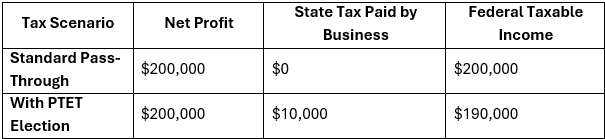
When the company utilizes the PTET election, the business pays the $10,000 state tax directly. The business deducts that amount as an operating expense, reducing its federally reportable net profit to 190,000 dollars. The owner now only pays federal income tax on 190,000 dollars. If the owner falls into a 24% federal tax bracket, this single structural shift saves them 2,400 dollars in cold, hard cash.
Navigating PTE Election Rules Across Different States
The majority of US states that levy an income tax now offer some version of a PTET framework. However, state lawmakers did not write a uniform set of laws. Every state manages its own PTE election rules, deadlines, and administrative processes, which means you must review your specific local guidelines carefully.
When assessing your local state requirements, pay close attention to these three variables:
- Strict Annual Deadlines: Missing a state' selection deadline can bar your business from participating for the entire calendar year. Some states require you to make the election by March 15th of the tax year, while others allow you to make the choice up until the day you file the entity tax return.
- Irrevocable Decisions: In many jurisdictions, once your business checks the box to opt into the PTET program for a specific tax year, you cannot change your mind. The decision remains completely binding for that year, even if your actual year-end financial metrics reveal that the election hurt your overall tax position.
- Owner Consent Requirements: States hold different standards for how a business approves the election. Some states allow a single managing member or majority owner to make the choice for the whole company, while other states require unanimous written consent from every single partner or shareholder.
Pitfalls of Multistate Tax Compliance
If your small business operates in multiple states, generates revenue outside your home borders, or has partners who live in different parts of the country, multistate tax compliance can get complicated quickly.
To keep your multi-state operations running smoothly, look out for these specific traps:
The Resident Credit Trap
When your business pays PTET to another state, your home state might not give you a full personal tax credit for it. If your home state refuses to recognize that out-of-state payment on your personal return, you or your partners could easily face double taxation on the exact same income.
Non-Resident Shareholder Issues
Out-of-state owners often face unexpected filing requirements or find themselves trapped in states with mismatched tax rates. This can complicate your overall S corp tax strategies if an election helps one partner but penalizes another.
The Need for Custom Modeling
Because every state has different rules, you cannot use a one-size-fits-all approach. You must model out the specific tax impact for each individual owner before making an election across multiple states to avoid unexpected tax bills.
Conclusion
The Pass-Through Entity Tax remains one of the most powerful tools available for small business owners looking to reduce their federal tax burden. By converting a restricted personal deduction into a fully deductible corporate expense, you can legally claw back thousands of dollars that would otherwise go to the federal government.
However, navigating the specific state deadlines, entity requirements, and multi-state filing traps takes careful oversight. If you want to make sure you are maximizing your federal tax savings without triggering costly state compliance issues, contact our advisory team. Book a call to evaluate your business structure and implement a clean, profitable tax strategy.

About The Author
Daniel Kaufman, is a CPA with over 20 years of experience helping businesses plan with confidence. He helps business owners understand their financial numbers and make smarter decisions for long-term growth. Daniel specializes in small business tax planning, setting up accounting systems, and is a QuickBooks ProAdvisor. He is passionate about giving business owners clarity and confidence through better financial insights.
FAQs
Is the PTET mandatory for pass-through businesses?

No, the PTET is an entirely optional election. Your business must actively choose to opt into the tax program each year by submitting the required state forms and making timely estimated payments.
Which business structures can use the PTET workaround?
Generally, partnerships, multi-member LLCs, and S Corporations qualify for the election. Sole proprietorships and single-member LLCs that file a Schedule C on their personal tax returns usually cannot use it.
Does my business still pay federal income tax under PTET?
No, business entity cannot pay federal income tax itself. The PTET only changes how your state income taxes are paid and processed, which ultimately lowers your personal federal taxable income.
What happens if I miss the PTET election deadline?
If you miss your state's official deadline, your business loses the ability to pay taxes at the entity level for that tax year. You must file under traditional pass-through rules and face the personal SALT cap.
Do I still have to file a personal state tax return if my business pays PTET?
Yes, you have to fileyour personal state income tax return. You will report your business earnings on that return and apply the state-provided PTET credit to wipe out or reduce your personal tax liability.
Read More Blogs

HVAC Business Valuation Multipliers: How Buyers Value Mechanical Contracting Firms
Bookkeeper vs Fractional CFO: Which Financial Advisory Does Your Business Need?
Connect with our experienced CFO advisory team
Get Insights
Submit the contact form to receive tailored financial insights and practical guidance from our team
Seamless Experience
Share your needs through the form for quick responses and smooth onboarding support.
Pricing That Makes Sense
After reviewing your inquiry, we provide transparent, practical pricing aligned with your business's financial needs.