
Fractional CFO vs. Tax CPA: What Is the Difference and Which Do You Need?
✅ Information Verified by a CPA




Running a growing business forces you to wear a dozen different hats. In the early days, managing your money usually meant handing off receipts to a local tax professional once a year and checking your bank balance every morning to make sure payroll cleared.
As your annual revenue pushes past the seven-figure mark, financial management gets complicated. You start asking bigger, harder questions. Can we afford to hire three new account managers next quarter? Why are our profit margins shrinking even though sales are up? Should we take on a line of credit to finance new equipment?
When founders start wrestling with these questions, they often turn to their tax CPA for answers, only to realize the advice falls short. That is not because your CPA is bad at their job. It is because tax compliance and financial strategy are two completely different disciplines.
To scale your business safely, you need to understand the distinct roles a Fractional CFO and a Tax CPA play, how they work together, and which one your company needs right now.
The Core Difference
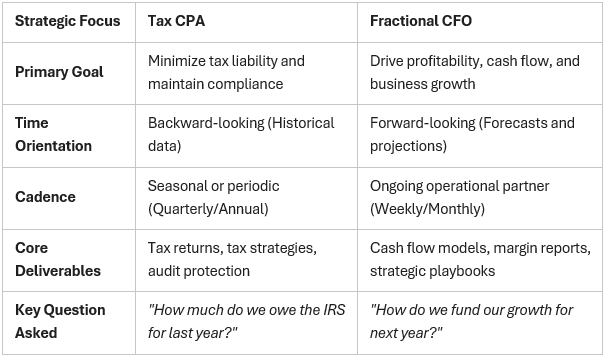
The easiest way to understand the difference between a Tax CPA and a Fractional CFO comes down to direction:
- Your Tax CPA looks in the rearview mirror. Their primary job is compliance. They record what already happened in your business, ensure your books match federal and state standards, maximize legal deductions, and keep you on the right side of the IRS.
- Your Fractional CFO looks out the windshield. Their primary job is strategy. They take your financial data to project where your business is going, mapping out future cash flow, optimizing profit margins, and helping you make major expansion decisions with confidence.
Think of it like driving a car. Your CPA tells you how fast you were going and how much gas you used during the last lap. Your CFO tells you how much fuel you need to make it through the next mountain pass, and which turn to take to avoid a pileup.
What Does a Tax CPA Do for Your Business?
Certified Public Accountants specializing in tax focus on precision, regulatory rules, and tax mitigation. Their core responsibilities include:
- Filing Annual Tax Returns: Preparing accurate federal, state, and local business tax filings to avoid penalties and audits.
- Tax Planning and Structuring: Identifying eligible deductions, tax credits, and choosing the optimal corporate entity structure (like S-Corp vs. C-Corp) to minimize your overall tax burden.
- IRS and State Compliance: Representing your business during audits, resolving tax notices, and making sure quarterly estimated payments are calculated correctly.
- Year-End Financial Clean-Up: Reviewing historical ledger transactions to ensure your year-end books match official tax standards.
A great CPA protects your hard-earned money from being eaten up by unnecessary taxes and ensures you stay compliant with complex tax codes.
What Does a Fractional CFO Do for Your Business?
A Fractional CFO provides high-level financial leadership on a part-time or retainer basis. Instead of paying a full-time executive salary over $300,000, you get strategic guidance tailored to your exact operational needs. Their core responsibilities include:
- 13-Week Cash Flow Forecasting: Building dynamic cash models so you always know your exact liquid position weeks before payroll, inventory purchases, or debt obligations hit.
- Profit Margin Analysis: Drilling down into your job costing, service lines, or client roster to identify which areas generate real profit and which ones secretly drain cash.
- Scenario Planning and Decision Support: Stress-testing big moves before you make them, like hiring key executives, opening a new location, or taking on debt.
- Capital and Credit Strategy: Preparing institutional-grade financial packages to secure bank lines of credit, negotiate vendor terms, or pitch investors.
A great Fractional CFO turns your financial data into a growth engine, helping you build real enterprise value.
Which One Does Your Small Business Need Right Now?
The decision between a CPA and a CFO comes down to your current revenue, operational complexity, and growth goals.
You only need a Tax CPA if:
- Your revenue is under $1M andyour business model is straightforward.
- Your cash balance is stable, and you are not making major capital investments.
- Your biggest financial headache is making sure quarterly tax payments are paid accurately and on time.
You need both a Tax CPA and a Fractional CFO if:
- Your revenue is between $1M and $10M+ and your operational complexity is rising fast.
- Sales are growing, but your cash account stays stubbornly flat or fluctuates wildly.
- You are making big strategic moves like launching new products, buying real estate, or hiring senior leadership.
- You are tired of making major financial decisions based on raw gut feel.
How They Work Together as a Power Team
You do not have to choose between a CPA and a Fractional CFO. In fact, fast-growing companies achieve the best results when both work in tandem.
Your Fractional CFO builds clean accrual accounting systems, optimizes your monthly gross margins, and keeps your balance sheet tidy all year long. When tax season arrives, your CPA receives pristine, well-organized financial records. This allows your CPA to focus on advanced tax strategies rather than wasting billable hours sorting through messy transaction data.
Conclusion
Relying on a tax professional to guide your day-to-day operations is like relying on a mechanic to drive your race car. Both are vital, but their roles are completely different. When you combine backward-looking tax compliance with forward-looking financial strategy, you gain total control over your company's financial future.
If your business has crossed the million-dollar mark and you want to stop guessing about cash flow, profit margins, and growth investments, let us help. Schedule a discovery call with Atheneum CFO today to see how our financial advisory services can give you the executive clarity you need to scale with confidence.

About The Author
Daniel Kaufman, is a CPA with over 20 years of experience helping businesses plan with confidence. He helps business owners understand their financial numbers and make smarter decisions for long-term growth. Daniel specializes in small business tax planning, setting up accounting systems, and is a QuickBooks ProAdvisor. He is passionate about giving business owners clarity and confidence through better financial insights.
FAQs
Can my Tax CPA perform the duties of a Fractional CFO?

While some CPAs offer basic business advisory services, their core training and daily focus center on tax law and accounting compliance. Strategic CFO work requires deep expertise in operational financial modeling, unit economics, cash flow management, and capital allocation, which go well beyond standard tax preparation.
How much does a Fractional CFO cost compared to hiring a Tax CPA?
A Tax CPA typically charges per return, per project, or via a small quarterly compliance fee, ranging from a few thousand to tens of thousands of dollars annually depending on business complexity. A Fractional CFO operates on a predictable monthly retainer, usually between $3,000 and $10,000 per month, depending on the scope of strategic guidance required.
Will a Fractional CFO handle my annual tax filings?
No. Fractional CFOs focus on operational finance, growth strategy, and cash management. They prepare clean financial records and collaborate closely with your CPA, but your CPA will remain responsible for signing and filing your official tax returns.
What is the right company size to hire a Fractional CFO?
Most small-to-medium businesses see the highest return on investment from a Fractional CFO when they reach between $1M and $10M in annual revenue. At this milestone, financial complexity outpaces basic bookkeeping, making strategic executive guidance essential for sustainable growth.
How quickly can a Fractional CFO impact my business's cash flow?
A Fractional CFO usually makes an immediate impact within the first 30 to 60 days by installing a rolling13-week cash flow forecast, identifying immediate margin leaks, and auditing your accounts receivable process to accelerate collections.
Read More Blogs

How to Reduce Days Sales Outstanding to Accelerate Your Business Cash Flow

Accrual Accounting: Best Practices for Tracking Deferred Revenue and Subscriptions
Connect with our experienced CFO advisory team
Get Insights
Submit the contact form to receive tailored financial insights and practical guidance from our team
Seamless Experience
Share your needs through the form for quick responses and smooth onboarding support.
Pricing That Makes Sense
After reviewing your inquiry, we provide transparent, practical pricing aligned with your business's financial needs.