
CFO Business Plan Templates: What Every Founder Needs Before Scaling
✅ Information Verified by a CPA




When starting out, a business plan often sits in a drawer once the initial bank account is opened or the first seed check clears. Early survival depends on quick execution, finding product-market fit, and landing your initial clients.
As your business approaches or passes the million-dollar mark, the rules change. Running a growing company without a structured, multi-year plan is like building a house without a blueprint. However, off-the-shelf, fill-in-the-blank templates designed for early-stage startups will not help a mature business scale.
To grow predictably, you do not need a 50-page PDF full of generic fluff. You need a modular set of working templates that connect your daily operational choices directly to your cash flow, profit margins, and long-term enterprise value.
What Is a CFO Business Plan (And Why Founders NeedOne to Scale)?
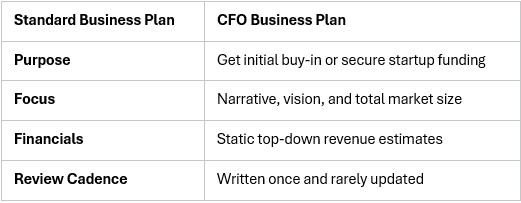
For early-stage startups, a standard business plan is usually a static, narrative-heavy document written to convince an investor or a bank that an idea is viable. It sits on a shelf once funding clears.
A CFO Business Plan is fundamentally different. It is an active, operational financial system designed specifically for founders running established businesses past $1M in revenue.
A high-level plan focuses on the mechanics of spendable cash. It translates your growth goals into connected financial models, mapping out exactly how revenue growth impacts your working capital, hiring capacity, tax liabilities, and profit margins.
For a scaling founder, a CFO business plan acts as a financial flight simulator. It lets you test major strategic moves on paper first, like hiring three key executives, opening a new office, or taking on a bank line of credit so you can see the exact impact on your liquid cash reserves six months before making a commitment.
Template 1: The One Page Strategic Executive Summary
Before diving into complex financial models, you need a high-level operational summary that keeps your leadership team, key managers, and external partners aligned on core goals.
A generic template focuses on fluffy mission statements. A scaling-focused executive summary focuses on unit economics and operational capacity:
- Core Value Proposition: What specific problem do you solve, and why do clients choose you over competitors?
- Ideal Client Profile (ICP): Who are your most profitable clients, and what are their defining traits?
- Unit Economics Snapshot: What is your average customer acquisition cost, deal size, and lifetime value?
- 12-Month Strategic Milestones: What are the three to five non-negotiable operational outcomes your team must achieve this year?
Keeping this document to a single page forces clarity. It serves as your north star during monthly performance reviews and quarterly planning sessions.
Template 2: The Integrated Business Model Framework
A business plan outlines your vision, but a business model template explains the physical engine that makes money. Many small businesses fail during growth phases because their operational cost structure expands faster than their top-line collections.
Your business model template must map out three distinct operational areas:
1. Revenue Streams
- Recurring Retainers, One-Off Projects, Product Sales, and Pricing Models.
- Defining how the business generates predictable top-line cash flow.
2. Cost Structure
- Direct Labor, Material COGS, Fixed Overhead, and Sales Commissions.
- Tracking the direct and indirect expenses required to deliver products and services.
3. Working Capital Logic
- Payment Terms, Invoice Collection Cycles, and Inventory Holding Times.
- Managing the operational timeline between spending cash on expenses and collecting cash from sales.
Documenting these dynamics helps you identify margin erosion early. If your delivery costs rise by 10% while client payment terms stretch from 30 days to 60 days, your template highlights the cash deficit before it hits your bank account.
Template 3: The Three Statement Financial Projection Model
The financial section is the heart of any scaling business plan. Static spreadsheets with arbitrary 20% annual sales bumps will not satisfy lenders, investors, or experienced CFOs.
Your financial projection template must link three core statements using a bottom-up methodology:
1. The Projected Income Statement (P&L)
Models monthly revenue across individual service or product lines, subtracting direct costs to monitor gross margins, and applying overhead expenses to determine net profit.
2. The Projected Cash Flow Statement
Adjusts net profit for real-world timing. It accounts for delayed client payments, inventory purchases, tax obligations, and principal debt payments to show true liquid cash positions.
3. The Projected Balance Sheet
Tracks cumulative assets, liabilities, and equity, giving lenders proof that your company maintains solvent ratios as debt or credit lines scale.
Template 4: The Strategic Business Proposal Template
When closing large enterprise deals, securing major vendor credit lines, or negotiating strategic partnerships, your business plan concepts translate into outward-facing proposals.
A formal business proposal template protects your margins and prevents scope creep by standardizing how sales agreements are written:
- Executive Summary of Need: Clear restatement of the client's problem and your proposed solution.
- Detailed Scope of Work: Specific deliverables, timelines, and explicit boundaries defining what is not included.
- Pricing and Payment Terms: Fixed fees or hourly structures tied to clear milestone payment schedules, including late payment penalties.
- Risk Mitigations and Guarantees: Clear terms regarding revisions, cancellations, and intellectual property rights.
Using a standardized proposal template ensures your sales team closes deals that fit your operational capacity and profit margin targets.
Conclusion
Filling out business plan templates is not a one-time exercise. In a healthy company, these models serve as living dashboards. When you compare monthly actual performance against your financial templates, variance highlights operational issues early, allowing you to protect cash flow and make confident hiring or investment choices.
Building dynamic, multi-year business models requires clear financial insight. Schedule a strategy call with Atheneum today to turn your business plan templates into a strategic roadmap for sustainable profit.

About The Author
Daniel Kaufman, is a CPA with over 20 years of experience helping businesses plan with confidence. He helps business owners understand their financial numbers and make smarter decisions for long-term growth. Daniel specializes in small business tax planning, setting up accounting systems, and is a QuickBooks ProAdvisor. He is passionate about giving business owners clarity and confidence through better financial insights.
FAQs
What is the difference between a standard business plan and a CFO business plan?

A standard business plan is typically a static narrative document created to present a business idea to bankers or early investors. A CFO business plan is an active operational model designed for growing companies past $1M in revenue, focusing directly on unit economics, cash runway, gross margins, and multi-statement financial modeling.
How often should a growing business update its business plan template?
While your long-term vision may stay constant, underlying financial models and operational assumptions should be reviewed quarterly. Updating forecasts every 90 days ensures your plan reflects shifting market conditions, actual sales conversion rates, and real overhead costs.
Can I use a standard one-page template when applying for a bank loan?
No, a one-page summary works well for internal alignment, commercial lenders and SBA loan officers require a comprehensive business plan. This includes full historical financial statements, a detailed 3-year three-statement projection model, debt service coverage calculations, and market analyses.
What is the biggest mistake founders make with business plan templates?
The most common mistake is relying on top-down revenue guesses rather than bottom-up operational modeling. Predicting sales based on arbitrary market percentages rather than actual lead volume, conversion rates, and team capacity results in unrealistic plans that fail inexecution.
Should I hire a professional to build my financial projection templates?
Yes. As your business crosses $1M in revenue, standard spreadsheet templates become inadequate. Working with a Fractional CFO ensures your financial models accurately link your P&L, Cash Flow, and Balance Sheet, giving you reliable data for strategic decision-making.
Read More Blogs

How to Build Accurate Financial Projections for Your Business Growth Plan


Connect with our experienced CFO advisory team
Get Insights
Submit the contact form to receive tailored financial insights and practical guidance from our team
Seamless Experience
Share your needs through the form for quick responses and smooth onboarding support.
Pricing That Makes Sense
After reviewing your inquiry, we provide transparent, practical pricing aligned with your business's financial needs.